I had a lot of fun researching the road signs and thought I’d delve into another area of mystery: roads themselves. So today, I’ll look at weird things like road striping, road dots, and the interstate system in general.
The lines on highways are 6″ wide. Dashes are 30 feet apart and 10 feet long. They’re made with either paint or tape.
Road paint is one of three types: water base, polyester or epoxy. Under ideal conditions (temperature/moisture), it takes 3 minutes to dry. 16 gallons of paint are used per mile of line. Glass beads (96 pounds per mile) are mixed into the paint to make it reflective at night. Paint costs $5.00 per gallon (yellow or white), and glass beads are $0.14 per pound, probably cheaper in bulk. (I’ve seen numerous spams from China buying these in 10 metric ton lots. Don’t know where I’d put them…)
Reflective tape is sometimes used as an alternative to paint in areas requiring multiple repaintings a year. Think urban. You can buy a 90′ spool of 6″ tape, in either yellow or white, for $341.50.
But what about the lane dots? Glad you asked.
Reflective pavement markers were adopted for use in California in the 1950s (from British invention during WWII). The intial model, known as “Bott’s Dots,” after Dr. Elbert D. Botts, were raised and had the added benefit of providing vibrational feedback to drivers straying from their lanes. Unfortunately, they weren’t very visible at night, and the Stimsonite company (now a subsidiary of Avery Dennison) was asked to to redesign them. The initial designs were very successful, but areas using snowplows necessitated further design refinements in the 1970s.
Reflectors are made of acrylic plastic covered with a thin glass layer. For most roads, they’re 4″ long, 4″ wide, and 0.7″ high, and weigh about 7 1/2 ounces each. Cost varies on volume, but they appear to be about $0.89 each in boxes of 100.
Installation of these is pretty straightforward: clean and dry the surface (usually with a sandblasting apparatus), apply adhesive, and press into place. Also interesting: reflectors are “self-cleaning.” They assume that people are going to hit them and the tires wiping over them removes road grime.
In areas where snowplows are used, reflectors embedded within a cast iron housing are used. These are 10″ long, 5 1/2” wide and almost 2″ high, though all but 1/2” of that is stuck into the road. The iron housing adds a lot of weight, making these babies top out at 5 1/2 pounds each. I wasn’t able to find any pricing on these, but they’re likely to be substantially higher because of the iron casing and you won’t get super saver shipping!
Reflective pavement markers have a useful life of 4-10 years, and the iron casings of the snowplow versions can be reconditioned.
Highways
Contrary to the urban legend, the interstate highway system was never designed to be used for emergency airstrips in case of war. (Source: Richard Weingroff, Federal Highway Administration) Practically speaking, the traffic, bridges, street signs, and other impediments would make this dangerous to use.
All but five state capitals are serviced by the interstate system. Those unlucky five are: Juneau, AK (inaccessible by roads in general); Jeferson City, MO; Dover, DE; Pierre, SD; and Carson City, NV (no relation). (Yes, Honolulu is on an interstate 😉
Major Interstate routes are designated by one- or two-digit numbers. North-south routes are odd numbered while east-west routes are even numbered. For north-south routes, the lowest numbers begin in the west, while the lowest numbered east-west routes are in the south. Thus I-5 is on the west coast, I-10 in the southern part of the US.
I-35 has two areas where there are parallel branches: In Texas, I-35 splits at Hillsboro with I-35E going through Dallas and I-35W going through Ft. Worth. (No, they really are separate cities.) They merge in Denton, home of the Rocky Horror Picture Show.
I-35 does something similar in Minnesota with Minneapolis and St. Paul, second cousins of Dallas and Fort Worth.
Some places have connectors with three digits. Loops are designated with the number of the main route and an even number prefix. For example, I-405 circles east of Seattle, connecting with I-5 at both points. Radial and spur routes use an odd-numbered prefix. For example, I-105 in Eugene, OR, connects with I-5 at its eastern terminus.
In cases where there are multiple circle/spur routes intersect a major freeway, different prefixes are used. For example, in northern California, you have I-280, I-480 and I-680. However, the system resets across states — San Diego also has an I-405.
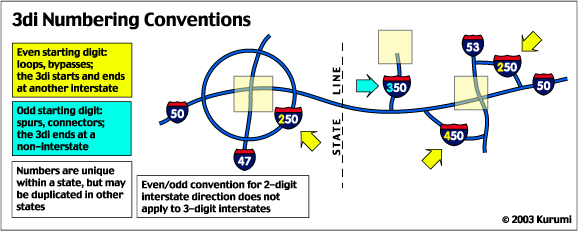
Got it? Okay, here are some exceptions.
The interestate system is 46,726 miles and worth of some top fives:
(Source: Federal Highway Administration)
Longest Interstate Routes:
I-90 Seattle, WA to Boston, MA 3,020.54 miles I-80 San Francisco, CA to Teaneck, NJ 2,899.54 miles I-40 Barstow, CA to Wilmington, NC 2,555.40 miles I-10 Los Angeles, CA to Jacksonville, FL 2,460.34 miles I-70 Cove Fort, UT to Baltimore, MD 2,153.13 miles Shortest (2-Digit) Interstate Routes:
I-73 Emery to Greensboro, NC 12.27 miles* I-97 Annapolis to Baltimore, MD 17.62 miles I-99 Bedford to Bald Eagle, PA 53.00 miles* I-19 Nogales to Tucson, AZ 63.35 miles I-66 Strasburg, VA to Washington, DC 74.80 miles (* Additional miles of I-73 in NC and I-99 in PA are expected to be built) East-West Transcontinental Routes:
I-10 Los Angeles, CA to Jacksonville, FL 2,460.34 miles I-80 San Francisco, CA to Teaneck, NJ 2,899.54 miles I-90 Seattle, WA to Boston, MA 3,020.54 miles North-South Transcontinental Routes:
I-5 San Diego, CA to Blaine, WA 1,381.29 miles I-15 San Diego, CA to Sweetgrass, MT 1,433.52 miles I-35 Laredo, TX to Duluth, MN 1,568.38 miles I-55 New Orleans, LA to Chicago, IL 964.25 miles I-65 Mobile, AL to Gary, IN 887.30 miles I-75 Miami, FL to Sault Ste Marie, MI 1,786.47 miles I-95 Miami, FL to Houlton, ME 1,919.74 miles
States with Most Interstate Mileage:
Texas 17 routes 3,233.45 miles California 25 routes 2,455.74 miles Illinois 23 routes 2,169.53 miles Pennsylvania 22 routes 1,759.34 miles Ohio 21 routes 1,572.35 miles
States with Most Interstate Routes:
New York 1,674.73 miles 29 routes California 2,455.74 miles 25 routes Illinois 2,169.53 miles 23 routes Pennsylvania 1,759.34 miles 22 routes Ohio 1,572.35 miles 21 routes
Most Costly Routes (Eligible for Interstate Construction Funds Based on 1991 Cost Estimate):
I-95 Miami, FL to Houlton, ME $8.0 B I-90 Seattle, WA to Boston, MA $7.5 B I-75 Miami, FL to Sault Ste Marie, MI $5.1 B I-10 Los Angeles, CA to Jacksonville, FL $5.0 B