N1MM+ and CWT

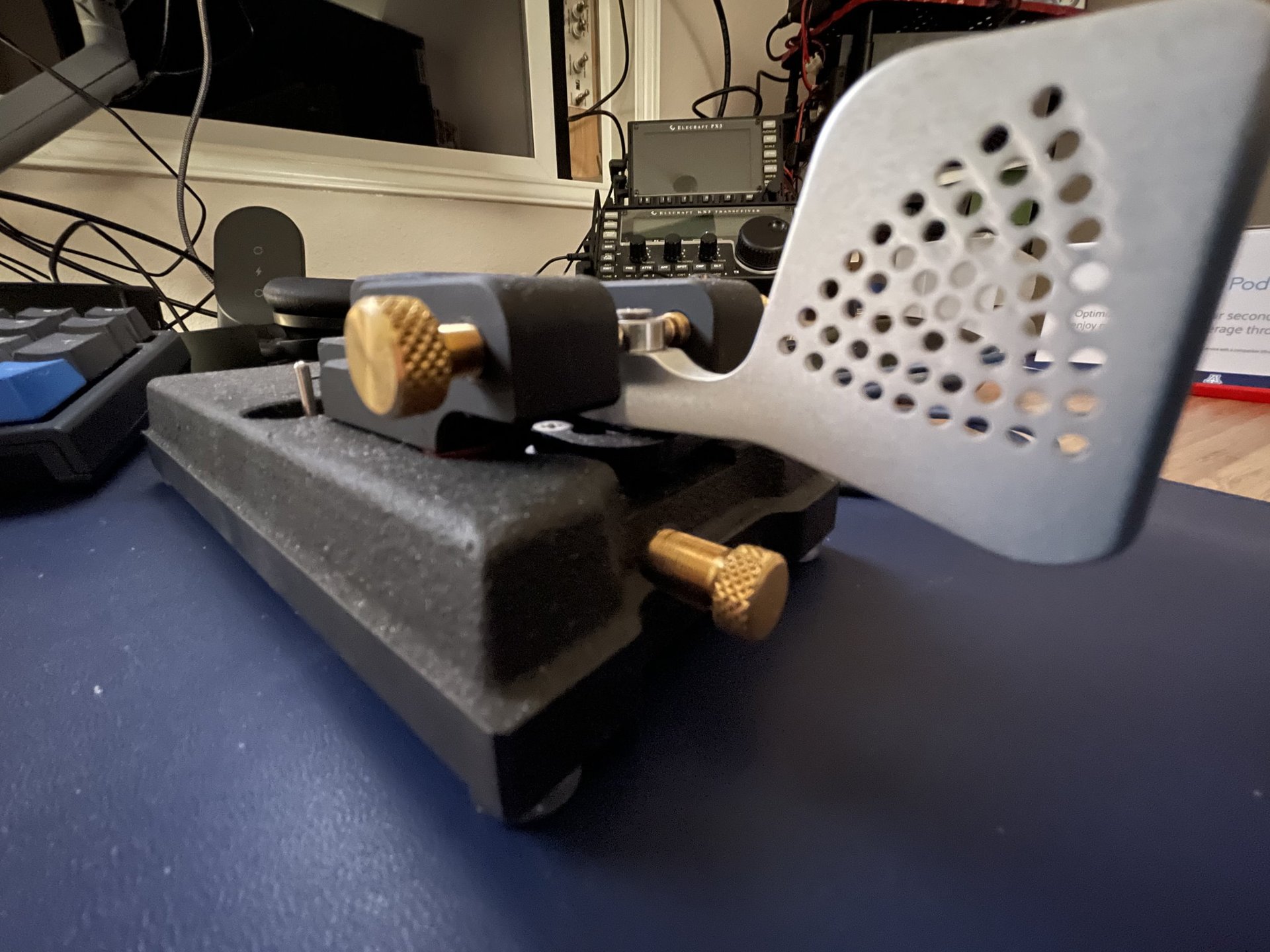
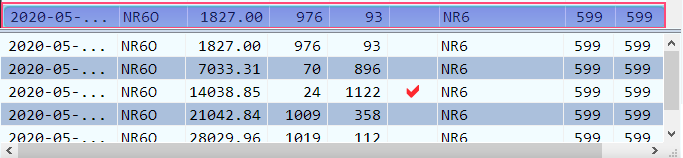
There is also a walkthrough of N1MM+ here that I did for my intermediate class earlier this week. Some definitions CW– stands for continuous wave, a simple method of communication where a signal is either on or off. It uses Morse Code, consisting of dots, dashes, and spaces. A dot is a tone emitted for one time-unit, a dash is a tone emitted for three-time-units. Spaces between dots and dashes, letters, and words are one, three and seven time-units, respectively. WPM– words per minute is a gauge of how fast one is communicating. For Morse code, we typically use the word “Paris” (.–. .- .-. .. …) as the standard “unit.” As a comparison, I can write about 15 words per minute, type about 70 wpm. CWT– is CWOps‘ CW contest held 3x a week, on Wednesdays at 1300Z, 1900Z, +0300Z. It’s a one-hour contest where the average communication speed is well-above 25 wpm. N1MM+ – this is a popular amateur radio contest logging program. KX3 – Elecraft’s all-mode transceiver. Thus, this blog entry covers how to use the N1MM+ software while participating in the weekly CWT contest. N1MM+ can be used for a variety of other events, not exclusively CWT or even Morse Code. ...
March 12, 2021 · wt8p

CWA Basic: Sessions 14 – 16

Sending in-class: Compose two “Dad Jokes” to send. For example: “Two guys stole a calendar. They got six months each.” (Or: “What do you do with an elephant with three balls? Walk him and pitch to the rhino.”) We’ll practice more sending of longer passages. Revisit the Wikipedia front page: https://en.wikipedia.org/wiki/Main_Page and pick a couple of items from Did you know… or On this Day — there is an extensive “Archive” link that will add variety — and summarize them for sending via CW. We’ll probably only have time for one, but in case we can do another, let’s do. We’ll do an exercise where you’ll call a classmate on Zoom, ask a simple question, they’ll reply, then onto the next classmate. Suggested subject areas: weather, HF rig, antenna, dinner, car, next vacation destination. The added variety is listening for your call sign and sending a classmate’s. If you are unable to copy, send a ? for resend. An exchange might look like this: W7PEZ de WT8P what is your rig?My rig is icom ic7300 WS6Y de W7PEZ how big is hexbeam?The hexbeam is 5280 feet. KJ7IZT de WS6Y … ...

February 27, 2021 · wt8p

CWA Basic: Sessions 11-13

We’re at the two-thirds/homestretch-ish point in the class. The speed creeps up 1 wpm for each the next few sessions, eventually hitting 13. Remember the overall goals are: having fun, making friends, and picking up a new skill for a lifetime. Absent from these goals is “beating yourself up because you didn’t hit flawless 13wpm on the nanosecond the 13wpm session started.” Learning CW takes time. The CW Academy classes have a very ambitious pace for learning a new skill. It’s rare that everyone lands on the same point. So, relax, relish how far you’ve come(*), and, please, proceed at your own pace. (*If you’d like some perspective, retry the self-assessment tool – scroll down about halfway: and see how far you’ve progressed.) … but not as much time as it’s going to clean my “office” when the Pandemic is over ...

February 17, 2021 · wt8p

CWA Basic: Sessions 8, 9 and 10

For Session 8 sending in class: What are your three most valued (to you) household appliances and/or power tools? (e.g., KitchenAid mixer, coffee grinder, and cordless drill) This weekend are two additional possible contact events for QSOs: CQ Magazine World-Wide CW sprint on 160m – The exchange is simply a signal report of 5NN and your state. Based on my hour last night, there were a lot of potential CA and WA contacts. (I could hear a few AZ/UT, but they could not hear me, which is a summary of my experience on 160m.) Look from 1.81 – 1.90 MHz. ...

February 12, 2021 · wt8p

CWA Basic: Session 6 and 7

As we all have felt, it’s quite normal to feel self-induced pressure at not maintaining perfection and, God forbid, be tempted to drop out and do it another time. A better way of looking at it is “if you stick around, will you be further along in your CW journey (and knowledge of Scottish inventions)?” Obviously, the answer is yes (though I’m biased :). And, as a bonus, you get to hang out with a great group of fellow hams, have fun and improve your skills. (Consider how much you’ve progressed in a short time!) I’ve found the sweet spot is to shoot for about 80% of the homework, on average. Sometimes you’ll be rocking it, sometimes it’ll feel not, but overall, you’re making good progress and friends. ...

February 3, 2021 · wt8p

CWA Basic: Sessions 4 and 5

Sessions 4 and 5 repeat the prior sessions, but bump up the Farnsworth speed to 5 then 6. It doesn’t look like a lot until you’re trying to listen! As I mentioned, it’s very common to feel an adrenaline bump when it’s your turn to send. If you mess up, or are feeling flustered, take a deep breath, send eight dits, take another breath, and start the word again (unless it’s like the last letter that would be understandable from context). Add more spacing if you like. Just remember, you’re among friends and it’s all about having fun. ...

January 29, 2021 · wt8p

CWA Basic: Sessions 1 – 3

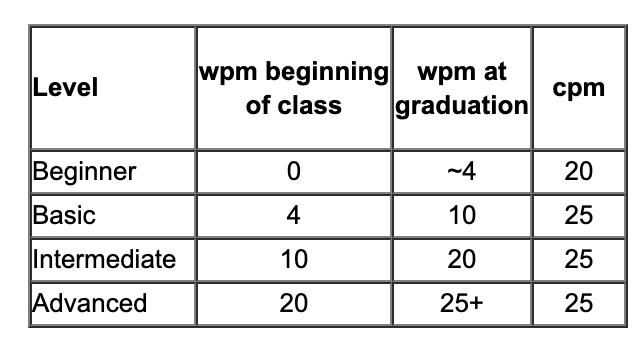
The basic class — which I really wish existed when I took CW Academy – serves as a bridge between beginner and intermediate. Its focus is on Instant Character Recognition (ICR), the ability to hear letters (initially) and words (later) as one unit without any additional steps. The bulk of the official syllabus — which you should glance through as it is the best of the four — uses the Morse Code Trainer web tool. How the 16 sessions work out ...

January 26, 2021 · wt8p

CWA Beginner – Session 16

For our last, unstructured session, we’ll do some more sending and copying using these lists of fruits and vegetables, and animals. As with the exercise we did with the state abbreviations, send a word to the next person, they’ll send the word back, “R” if correct. (If they don’t copy, “?” to resend) They’ll send a word to the next person, and so on. Welcome, Session 01, 02, 03, 04, 05, 06, 07, 08, 09, 10, 11, 12, 13, 14, 15, 16 I’ve created a brief tutorial on Morse Runner. On the most basic level, this program is used to practice simple exchanges (call sign + serial number). When it calls you, if you don’t get the full call sign, you can either do nothing and wait for it to resend, hit F7 (?) or try a partial and F5. The partial is useful in a “pileup,” that is, if several stations responded but you only got a partial on one, you’d send what you had and the other stations should ignore it. (In practice, and occasionally in the program, that doesn’t always happen.) The default time run-time in Morse Runner is 60 minutes, but I would not run it more than 10 or 15 minutes because it gets tedious. ...

November 10, 2020 · wt8p

CWA Beginner – Session 15

This is the ad hoc, unscripted part of the course. Welcome, Session01,02,03,04,05,06,07,08,09,10,11,12,13,14,15,16 Bonus homework: If you can, listen to the K1USN SST on Sunday either on air or via Web SDR, see what you can pick off. If you want to try to make an on-air contact, that would be awesome, too. As a reminder, the exchange information is here. In class, let’s try a few exercises with state capitals: (Warmup) Send a two-letter abbreviation to the next person. If they copy, they’ll repeat it back, sender acknowledges with an “R”. Recipient then picks a two-letter abbreviation to send to the next person, and so on. If they don’t copy, send a question mark for al resend. We’ll see if we can do a few quick rounds. ...

November 6, 2020 · wt8p

CWA Beginner – Session 14

For the bonus homework: Compose an amateur radio-related haiku, a three-line poem where the lines are 5, 7, and 5 syllables, respectively. Some examples from a prior class are below. As you practice at home, think of where it would be appropriate to add additional spacing to compensate for the lack of context clues: No propagationUntil someone calls CQThen the bands open CWTAt 40 words per minuteIs too fast for me ...

November 3, 2020 · wt8p